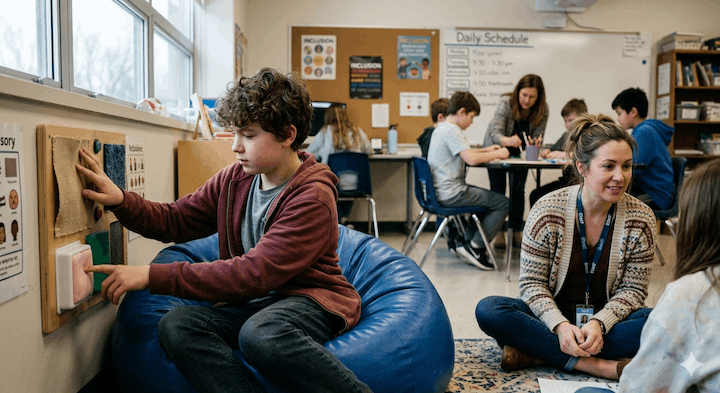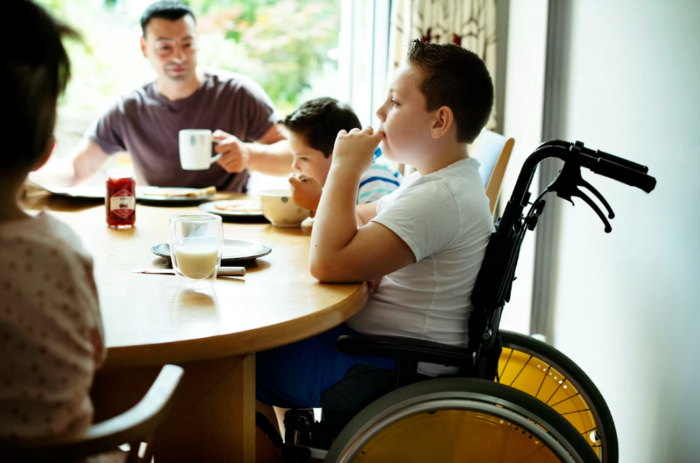
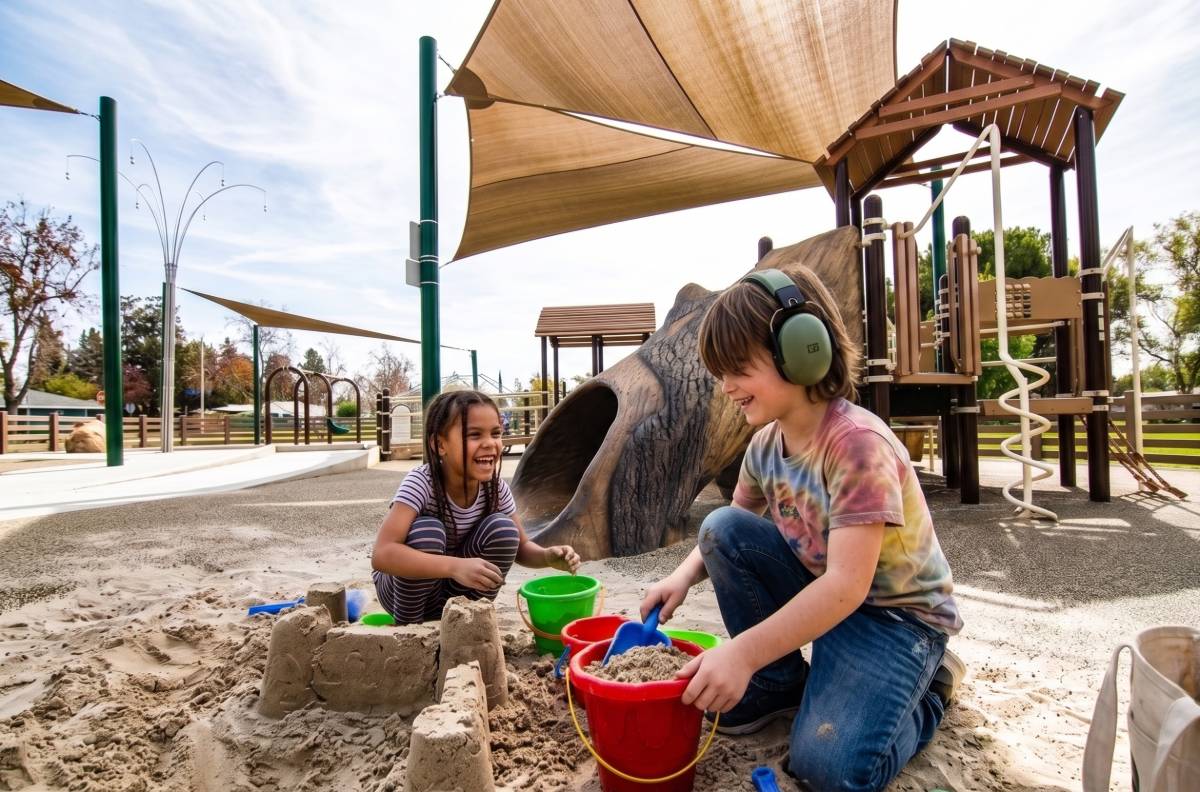
Short answer: When an autistic child stands alone at the playground, they almost always want to play. They don't have the skill to walk up and ask. That skill won't show up on its own the way it does for neurotypical kids. It has to be rehearsed at home and coached at the park. The four moves that work for most families in our San Fernando Valley practice: prep a script at the kitchen table before you go, run ball-catch near other kids as the starter drill, whisper the ask from behind your child and fade back over six to eight visits, and reward each attempt during the play instead of after it. This runs alongside in-home Adaptive Skills Training, not instead of it.
Most of what happens after an autism diagnosis doesn't happen in a clinic. It happens at the park, in the cereal aisle, on the ride to school. A specialist teaches the skill in a quiet room. You're the one who makes it work everywhere else. That second job is yours, and the playground is one of the hardest places to do it.
A mom I worked with last year described it perfectly. Her six-year-old would walk to the edge of the play structure, stand there, and watch. Not upset. Not melting down. Just frozen. She'd sit on the bench for twenty minutes hoping he'd figure it out, then take him home feeling like she'd failed. When we talked about it, she said, "I thought he just didn't want to play." He did. He had no idea how to walk into a group of kids and open his mouth. That's the part most parents get wrong, and it changes everything once you see it.
Why does my autistic child stand alone at the playground?
Because the skill is missing, not the desire. I've done thousands of intakes over twenty-three years, and the parents who come in thinking their kid prefers to be alone are almost always reading the freeze wrong. The kid who looks checked out at the park is usually stuck. They want in. They don't know what to say, where to stand, or when to jump in. They wait for a gap. The gap closes. They freeze. The parent on the bench reads the freezing as a choice, gives them space, and the pattern locks in.
Here's the part I end up saying in almost every intake: you are the coach. Not the specialist. You. The specialist who comes to your house is teaching scripts in a calm room, and that work matters. But a script your child only uses in the living room with an adult they're comfortable with is not the same skill as walking up to a kid at Lake Balboa and saying "can I play." The person at the park decides whether the script transfers. That person is you.
How do I prep my autistic child before going to the playground?
Do it at the kitchen table, hours before the visit. Not in the car on the way. The kids who actually try something new at the park rehearsed it earlier in the day, sometimes earlier in the week. Three things to cover: what the park looks like, what your child is going to say, and what counts as a win.
Pull up a photo of the park on your phone. Walk through it. "We're going to Reseda Park. We'll start at the swings. After that, we're going to find one kid and you're going to say, 'can I have a turn.'" Then practice. Have a sibling or the other parent play the part of a random kid. Run the version where the kid says yes. Run the version where the kid says no or says nothing. That second version matters more than the first, because it's what actually happens most of the time.
For the target, pick something small and countable. Three asks. One round of catch with a peer. Not "have fun" or "try to make a friend." Those are too big and too vague for a kid who froze last time.
- A photo of the specific park on your phone, walked through together before you leave the house
- One scripted line practiced at home with a sibling or parent playing the other kid ("Can I have a turn?" is the best starter)
- A countable target for the visit (three asks, one catch, one peer interaction)
- A snack in the car for the ride home so the exit doesn't become the meltdown
What's a good starter drill for a kid who won't approach other children?
Ball-catch with you, ten feet from where the other kids are playing. You're the partner. You're not recruiting anyone yet. The whole point is to play a game that other kids can see and understand from twenty feet away without anyone having to explain it.
Play ball-catch near the group, not in it
I start with ball-catch because it sidesteps almost every reason kids freeze. There's no conversation. The motion repeats. Each throw-and-catch takes two seconds and resets. And the shape of the game is obvious to any kid watching from the slide: throw, catch, throw, catch. A peer can wander over and join without anyone making introductions.
Pick a spot about ten feet from the busiest play structure. Throw underhand. Keep each round to two or three minutes, then break. Sometimes another kid drifts over. Sometimes nobody looks up. Either way, your child just spent fifteen minutes doing a peer-shaped activity within view of other children, and that exposure is what makes the real approach feel less alien when you get there.
How do I coach my child to talk to other kids at the playground?
Stand close. Whisper the words. Let your child say them. Then stand further back next time. That's the whole method. You're behind your child, feeding them the line a beat before the opening shows up, and you pull back a little more on every visit until you're on the bench.
Whisper the line, let your child say it, move back each visit
Every parent I've watched try this for the first time lands at one of two extremes. They speak for their kid ("She wants to play with you"), or they sit on the bench hoping the ask will happen by itself. Speaking for your child skips the practice entirely. Sitting thirty feet away skips it too, just more quietly. The work is in the middle. Close enough to whisper. Far enough that the words come out of your child's mouth, not yours.
Stand a step behind. When an opening shows up (a kid pauses, a swing opens, a game has room), lean in and say quietly: "Can I have a turn." Your child repeats it. You step back. If the other kid responds, stay back. If your child freezes, wait. Don't prompt again immediately. Two seconds feels like ten when you're standing there, but the words usually come if you let the silence sit.
By visit three, you're a half-step further back. By visit six, you might be on the bench giving a thumbs-up instead of a whispered word. By visit eight, on a good run, you're not prompting at all. Some kids take longer. That's fine. The speed doesn't matter. The fading does.
How do I set up a playdate that actually builds social skills?
One peer. One activity. Forty-five minutes. Snack at the end. That's the shape. Open-ended hangouts slide into parallel play, which doesn't stretch anything. And two peers is almost always one too many, because your child has to track two sets of social cues instead of one, and the two peers end up playing with each other.
Keep the playdate small, short, and planned
Pick a kid your child already has some thin connection to. A cousin. A neighbor's kid. The same-age kid from preschool drop-off whose parent you've talked to a couple of times. Pick a park your child has been to enough that the layout isn't something they have to figure out on top of everything else. Bring one shareable activity: bubbles, sidewalk chalk, a soccer ball. Plan to be there forty-five minutes. End on a snack you brought.
This shape protects everyone. Your child practices without being asked to hold it together for an hour and a half. The other kid leaves before they're bored. The other parent says yes to the next one because the first one wasn't a disaster. You get way more reps from short visits that end well than from long ones that fall apart at minute fifty.
How do I reward playground social skills without bribing?
Reward during the play, not after. The most common first attempt I hear from parents is "if you play with three kids, you get ice cream on the way home." That sounds reasonable, but by the time you're at the ice cream shop, the connection between the ask and the reward is gone. The brain doesn't link them anymore. Reinforcement works when it lands within seconds of the behavior, not hours later.
Stack small rewards inside the visit
A high-five right after a peer ask, while your kid is still standing there, does more than a treat in the car. For most kids in our practice, the social reward alone is enough: a real smile, a "nice ask," a hand on the shoulder. Start with that. It's free and it works.
For kids who need something more concrete, bring a small tin and ten marbles. Each ask earns a marble. Five marbles convert to a small item on the way home that you picked together before the visit: a Hot Wheels car, a pack of stickers, something cheap enough that you can do it every single time. The reward stays close to the behavior. The item stays small enough to sustain.
One thing most parents don't think to do: when your child agrees to join a game they didn't pick, double the reward. That's a much harder skill than choosing a game and getting reinforced for it. A kid who says "okay" to another kid's idea instead of insisting on their own just did something really hard. The reward should reflect that.
Which San Fernando Valley parks work best for this practice?
The park matters less than you think. What matters: a contained perimeter if your child bolts, more than one play area so you can move if the main one gets overwhelming, and open grass for ball-catch away from the structures. But the best park for your family is the one your child has been to enough times that the layout is boring. New parks add a variable you don't need right now.
| Park | Why it works for practice | Best time to go |
|---|---|---|
| Aliso Canyon Park (Northridge) | Fenced playground, quiet on weekday mornings, open grass right next to the play area | Weekday mornings before 10:30 |
| Lake Balboa / Anthony C. Beilenson Park (Encino) | Multiple play areas so you can move when the crowd shifts | Weekend mornings or weekday late afternoons |
| Reseda Park | Big central grass field, predictable layout, easy to set up a planned playdate | Weekday afternoons 3:30 to 5 |
| Holleigh Bernson Memorial Park (Porter Ranch) | Newer equipment, calmer crowds, good for a first run | Weekday mornings |
Time of day matters more than which park you pick. The same kid will have a rougher visit at 4pm on a Saturday than at 10am on a Tuesday. Pick one home park and keep going back until the layout is something your child doesn't even notice anymore. New parks come later, after the scripts are solid.
When should I ask for help from a specialist?
When the park visits are producing more meltdowns than wins. When safety is a regular concern. Or when you're just running out of gas coaching this on your own, which is a completely reasonable place to land. This is hard work, and it was never meant to be something you do alone forever.
For most families we work with, the playground coaching runs alongside the Adaptive Skills Training that's already happening at home. The specialist teaches the script in the living room. You run it at the park. After a few months of that pairing, the playground isn't the place your day falls apart anymore. Some visits will still be rough. But most of them won't.
American Academy of Pediatrics: The Power of Play The AAP's clinical report on how play builds social and emotional skills in children →Playground practice FAQ
How long before my child approaches another kid without prompting?
Most kids make their first unprompted ask somewhere around visit six to ten, assuming the prompting has been consistent. Some take longer. What you're watching for is your voice fading out, not a specific timeline.
What if my child only wants to play with adults?
That's normal and not a problem. Adults are predictable, which is why they feel safer. Start with ball-catch with you, then move to a structured playdate with one familiar peer, then to the open playground. Don't skip the middle step.
What if the other kids ignore my child?
Expect it. Some asks get a yes, some get nothing. Practice the "walk away calmly" version at home before you go. An ask that gets ignored without a meltdown is a real win, and it deserves a high-five.
Should I tell the other kids my child is autistic?
Not as the opener. "He wants to play, he's still figuring out what to say" is enough for most kids. Save the longer conversation for an older kid who asks directly, or someone you're going to see regularly.
My child gets overwhelmed at the playground. Should we still go?
Not when the goal is social practice. If your child is already in sensory overload, the asking won't stick. Go earlier, stay shorter, or pick an emptier park. Save the busy Saturday afternoon for after the skills are more solid.
Does this work for older kids and teens?
Yes, with a different activity. For older kids, the shared interest replaces the ball: trading cards, skating, a portable game console. The playdate might be a trampoline park or a boba shop instead of Aliso Canyon. The structure is the same.
How does this fit with Adaptive Skills Training?
The specialist teaches the script in your home. The playground is where you put it to use. The two are designed to work together. If you want to see how getting started works, we walk you through the Regional Center request.